Once upon a time there were three sisters. Fluent in the make-believe language Arnish, they spent their dreaming moments in a faery realm. Banished from her daughters’ secret world, their mother spent most of her waking moments cultivating heirloom tomatoes in her garden.
Years passed. Once so close, the sisters realigned allegiances in high school when the eldest, Elv, began rebelling. Betrayed by her sisters into rehab, Elv met Lorry. Lorry instantly ensnared her heart with a tale of a youth spent living underground in abandoned subway stations. The two storytellers, with a little help from heroin, managed a life together. Meanwhile the youngest, Claire, unable to deal with life’s loss, moved into her grandmother’s Paris apartment. After a slice of Honesty Cake (fresh eggs, flour, sugar, lemon rind, anise seed and dry cherries), Claire was hired by a family friend to work in a jewelry store. Eventually, Claire won her sister back through charms crafted for Elv’s daughter Mimi. And they all lived happily ever after.
Or did they?
Alice Hoffman, like the protagonist of The Story Sisters, is a born storyteller. She breathes life into characters that join us on our commute, read over our shoulders, linger over dessert. Like others we spend our days around, they annoy, entrance, humor, and perplex us. Equally as perplexing is the ending. Heartbreakingly tragic or sigh-of-relief sweet? I’m still not sure. Maybe I’m just disappointed the tale had to end at all.
Wednesday, August 26, 2009


Wednesday, August 19, 2009
It's Your Turn
It all begins with a storybook wedding. Sex. Kids. And then either:
A) both parents work, children are cared for by someone else
B) one parent works, leaving the other parent as the “stay-at-home”
C) one parent works, one parent stays-at-home writing, and a housekeeper and nanny are hired
It’s a good thing she chose C.
Caitlin Flanagan has compiled a mope-conquering collection of essays examining woman’s work in To Hell with All That: Loving and Loathing Our Inner Housewife.
I first discovered Flanagan when I came across her article “Housewife Confidential” in the Atlantic. To Hell with All That includes an expanded version of this article which examines what the original housewife authors from Bombeck to Bracken had to say – don’t throw out your sense of humor with the dishwater.
Flanagan moves on to discuss the phenom of today’s mother’s little helper. Not valium. The nanny. After investigating the rise of the governess culminating in Disney’s Mary Poppins, Flanagan relates her own experience as the mother of twin boys and employeer of help more likely to be named Maria than Mary. Paloma, it turns out, is a godsend. She cleans, she cooks, she quiets the boys with a look. And Flanagan loves it. When she’s not questioning her own role in the whole endeavor.
After the boys have grown, Flanagan hires a housekeeper to take up where the nanny left off, which leaver her more time to manage the family’s schedule (and its clutter). Essays on both resonate and cheekily point out the ridiculousness of it all.
And then there’s the husband. Poor him. Really. He’s gone from the housewife’s main preoccupation to an afterthought somewhere between Little Gym and pet vaccinations in the stay-at-home’s day planner. Flanagan’s words from page 36:
“He must somehow seduce a woman who is economically independent of him, bone tired, philosophically disinclined to have sex unless she’s jolly well in the mood…and still doing a slow burn over his failure to wipe down the countertops and fold the dish towel after cooking the kids’ dinner. He can hardly be blamed for opting instead to check his e-mail, catch a few minutes of SportsCenter, and call it a night.”
I’m going to tape that quote to my fridge. Just as soon as I wipe that crusty stuff out of the produce bin and alphabetize the chutneys.
A) both parents work, children are cared for by someone else
B) one parent works, leaving the other parent as the “stay-at-home”
C) one parent works, one parent stays-at-home writing, and a housekeeper and nanny are hired
It’s a good thing she chose C.
Caitlin Flanagan has compiled a mope-conquering collection of essays examining woman’s work in To Hell with All That: Loving and Loathing Our Inner Housewife.
I first discovered Flanagan when I came across her article “Housewife Confidential” in the Atlantic. To Hell with All That includes an expanded version of this article which examines what the original housewife authors from Bombeck to Bracken had to say – don’t throw out your sense of humor with the dishwater.
Flanagan moves on to discuss the phenom of today’s mother’s little helper. Not valium. The nanny. After investigating the rise of the governess culminating in Disney’s Mary Poppins, Flanagan relates her own experience as the mother of twin boys and employeer of help more likely to be named Maria than Mary. Paloma, it turns out, is a godsend. She cleans, she cooks, she quiets the boys with a look. And Flanagan loves it. When she’s not questioning her own role in the whole endeavor.
After the boys have grown, Flanagan hires a housekeeper to take up where the nanny left off, which leaver her more time to manage the family’s schedule (and its clutter). Essays on both resonate and cheekily point out the ridiculousness of it all.
And then there’s the husband. Poor him. Really. He’s gone from the housewife’s main preoccupation to an afterthought somewhere between Little Gym and pet vaccinations in the stay-at-home’s day planner. Flanagan’s words from page 36:
“He must somehow seduce a woman who is economically independent of him, bone tired, philosophically disinclined to have sex unless she’s jolly well in the mood…and still doing a slow burn over his failure to wipe down the countertops and fold the dish towel after cooking the kids’ dinner. He can hardly be blamed for opting instead to check his e-mail, catch a few minutes of SportsCenter, and call it a night.”
I’m going to tape that quote to my fridge. Just as soon as I wipe that crusty stuff out of the produce bin and alphabetize the chutneys.
Wednesday, August 12, 2009
Gum Arabic
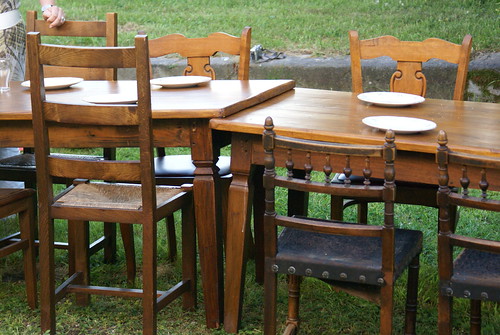
Grand-maman presides over the table covered in her mother’s tablecloth. Beautiful people lounge in mismatched wooden chairs set on the grass. It’s Sunday and children are in from the city seeking escape from their day jobs in publishing, finance, and children’s clothing design. Carafes of wine, children in spotless white, women in tastefully wrinkled linen. Cheese for dessert.
If you’ve been waiting to recreate such a scene, here’s the manual: A Well Kept Home: Household Traditions and Simple Secrets from a French Grandmother by Laura Fronty and Yves Duronsoy.
In this book, Fronty and Duronsoy have created a tisane of beautiful photographs (straw hats, lily oil), vintage recipes (Colette’s quince water, Dumas’ butter), and practical home keeping advice (returning the shine to glassware, keeping moths away with peppercorns). Sprinkled throughout are Fronty’s reminisces about lemon balm, ivy water used to wash silk, and a time when currants, quince pips, and bergamot oil were household staples.
Although I don’t own a straw hat, my wine glasses, sadly neglected, are cloudy. I took a recipe from this book and am, as I write, hoping the vinegar/egg shell mix works its magic. If it does, I may drag my own mismatched set of wooden chairs out on the lawn, sip a glass of wine, and savor the plate of plum cake at my feet – though I daresay my children won’t be wearing white anytime soon.
If you’ve been waiting to recreate such a scene, here’s the manual: A Well Kept Home: Household Traditions and Simple Secrets from a French Grandmother by Laura Fronty and Yves Duronsoy.
In this book, Fronty and Duronsoy have created a tisane of beautiful photographs (straw hats, lily oil), vintage recipes (Colette’s quince water, Dumas’ butter), and practical home keeping advice (returning the shine to glassware, keeping moths away with peppercorns). Sprinkled throughout are Fronty’s reminisces about lemon balm, ivy water used to wash silk, and a time when currants, quince pips, and bergamot oil were household staples.
Although I don’t own a straw hat, my wine glasses, sadly neglected, are cloudy. I took a recipe from this book and am, as I write, hoping the vinegar/egg shell mix works its magic. If it does, I may drag my own mismatched set of wooden chairs out on the lawn, sip a glass of wine, and savor the plate of plum cake at my feet – though I daresay my children won’t be wearing white anytime soon.
Wednesday, August 5, 2009
Square One
My dad is a man of habit. Every morning he pours a cup of coffee, opens the paper, and after reading the news, works the puzzles. From solving the Dallas Time Herald's crossword of 30 years ago or the Ft. Worth Star Telegram's sudoku of today, he is purportedly in great shape to stave off Alzheimer's. Or so I believed until picking up Dean Olsher's From Square One: A Meditation, with Digressions, on Crosswords.
Olsher doggedly fills in the pages of this book as one might solve the Sunday New York Times puzzle - going across with one topic, down to another, then back to the stumpers. Among the stumpers he tackles are why musical theater lyricists make great puzzle constructors, why more couples aren’t doing crosswords together, and why you should try belly dancing if you are really interested in delaying the onset of dementia (are you taking notes, Dad?).
Like Olsher, I habitually become obsessed with doing crosswords. Three hours into labor with my daughter found me working the Monday New York Times puzzle. Recuperating after the birth of my son, I worked through a Variety collection of word games. Usually the Sunday morning drive to church finds me listening for Will Shortz’ weekly puzzle challenge on NPR. I actually have been intending to see Wordplay, a movie Olsher mentions about competitive crossword tournaments. Now thanks to Olsher, I’ve got a new obsession – the cryptic.
By the end of his book, Olsher's moved away (or across) from crosswords to explaining the rules for solving cryptics. Perhaps Olsher's only trying to jumpstart the publishing industry with a new wave of cryptic books. After all, according to Olsher, Simon & Schuster got its start from the popularity of a series of "Cross Word" books in the 1920s. Farrar, Straus and Giroux received financial backing from Farrar's wife Margaret, who made her living as the NY Times crossword editor in the 1940s. Whatever his motive, Olsher succeeded in getting one reader to try her hand (and even more trying, her brain) at this cryptic. You can find instructions here, reader, if you are so inclined. If not, take it from Square One.
Olsher doggedly fills in the pages of this book as one might solve the Sunday New York Times puzzle - going across with one topic, down to another, then back to the stumpers. Among the stumpers he tackles are why musical theater lyricists make great puzzle constructors, why more couples aren’t doing crosswords together, and why you should try belly dancing if you are really interested in delaying the onset of dementia (are you taking notes, Dad?).
Like Olsher, I habitually become obsessed with doing crosswords. Three hours into labor with my daughter found me working the Monday New York Times puzzle. Recuperating after the birth of my son, I worked through a Variety collection of word games. Usually the Sunday morning drive to church finds me listening for Will Shortz’ weekly puzzle challenge on NPR. I actually have been intending to see Wordplay, a movie Olsher mentions about competitive crossword tournaments. Now thanks to Olsher, I’ve got a new obsession – the cryptic.
By the end of his book, Olsher's moved away (or across) from crosswords to explaining the rules for solving cryptics. Perhaps Olsher's only trying to jumpstart the publishing industry with a new wave of cryptic books. After all, according to Olsher, Simon & Schuster got its start from the popularity of a series of "Cross Word" books in the 1920s. Farrar, Straus and Giroux received financial backing from Farrar's wife Margaret, who made her living as the NY Times crossword editor in the 1940s. Whatever his motive, Olsher succeeded in getting one reader to try her hand (and even more trying, her brain) at this cryptic. You can find instructions here, reader, if you are so inclined. If not, take it from Square One.
Wednesday, July 29, 2009
If you like...
You've read everything Jodi Picoult has written. Now what?
Welcome to the world of "If you like" lists. I first discovered such lists on the Seattle Public Library website. Now, sadly, most of their resources are reserved for card holders. But a multitude of libraries have jumped on the book wagon and have lists accessible to anyone who can google.
Here are a few I found:
Clifton Park Library
Multnomah County Library
Oxford County Library
Wake County Public Libraries
By the way, if you do like Jodi Picoult, then you'll probably like Michelle Richmond's The Year of Fog and No One You Know.
Welcome to the world of "If you like" lists. I first discovered such lists on the Seattle Public Library website. Now, sadly, most of their resources are reserved for card holders. But a multitude of libraries have jumped on the book wagon and have lists accessible to anyone who can google.
Here are a few I found:
Clifton Park Library
Multnomah County Library
Oxford County Library
Wake County Public Libraries
By the way, if you do like Jodi Picoult, then you'll probably like Michelle Richmond's The Year of Fog and No One You Know.
Wednesday, July 22, 2009
Skimming the Stacks
So it seems I’ve fallen out of favor with the librarians. Somebody shelved the books I had on reserve leaving me no recourse but to quickly browse the shelves for something (anything) to read.
That’s how I found these three. As usual I have a knack for picking out the funny, the lyrical, and the heartbreaking.
We Are All Fine Here by Mary Guterson
Julia & Ray & Jim & Patricia. Julia is married to Jim, sleeps with Ray, and is jealous of Jim’s infatuation with Patricia. One pregnancy at 39 later, Julia‘s frank, funny observations of her mid-life predicament make you wish you said it first.
The Sky Below by Stacey D'Erasmo
A portrait of an artist as a young man pining for the time when his mother read him Ovid morphs into a day job at 39 writing obituaries of former Rockettes. At night, he spies on the owners of his dream house, ghost-writes a best selling pulp series, and creates assemblage boxes of found objects. After being diagnosed with cancer, he travels to Mexico and falls into a camp of misfits led by an indigo child. Winged but somewhat unhinged, he begins another transformation. More Marquez than New Agez, D’Erasmo’s prose pulls it off.
The End of the Alphabet by CS Richardson
Zephyr marries Zipper. Zephyr greets the neighbors on Sundays. Zipper writes for a fashion magazine. Zephyr finds out he has 30 days to live. Zipper accompanies him on an alphabetical last-days tour…Amsterdam, Berlin, Chartres. Poignant characters carry this slim novella though the conceit loses steam around LMNOP.
That’s how I found these three. As usual I have a knack for picking out the funny, the lyrical, and the heartbreaking.
We Are All Fine Here by Mary Guterson
Julia & Ray & Jim & Patricia. Julia is married to Jim, sleeps with Ray, and is jealous of Jim’s infatuation with Patricia. One pregnancy at 39 later, Julia‘s frank, funny observations of her mid-life predicament make you wish you said it first.
The Sky Below by Stacey D'Erasmo
A portrait of an artist as a young man pining for the time when his mother read him Ovid morphs into a day job at 39 writing obituaries of former Rockettes. At night, he spies on the owners of his dream house, ghost-writes a best selling pulp series, and creates assemblage boxes of found objects. After being diagnosed with cancer, he travels to Mexico and falls into a camp of misfits led by an indigo child. Winged but somewhat unhinged, he begins another transformation. More Marquez than New Agez, D’Erasmo’s prose pulls it off.
The End of the Alphabet by CS Richardson
Zephyr marries Zipper. Zephyr greets the neighbors on Sundays. Zipper writes for a fashion magazine. Zephyr finds out he has 30 days to live. Zipper accompanies him on an alphabetical last-days tour…Amsterdam, Berlin, Chartres. Poignant characters carry this slim novella though the conceit loses steam around LMNOP.
Wednesday, July 15, 2009
"No Deal?"
If I ever get Parkinson’s, don’t take me anywhere near this place. The dopamine stimulants used to treat the disease have been linked to an increased risk of gambling and other reward-based compulsive behaviors - behaviors that many might view as plain old poor decisions.
Poor decisions, and good decisions, are the subject of Jonah Lehrer’s How We Decide.
Opening with quarterbacks, Lehrer then follows a poker player, credit counselor, and soap opera director (among others) to illustrate the brain functions that guide our decisions. He delineates the different types of decisions we face from simple to complex and explains whether we should draw from the rational or emotional in making up our minds.
If a decision can be summarized in numerical terms, such as price, he suggests utilizing the prefrontal cortex. Therefore making the best decision on which cereal to spoon up or which suitcase to open on Deal or No Deal requires a little thought.
Likewise, he also suggests using reason to work out new problems. While we can rely on past mistakes and our gut when encountering most problems, novel crises require an application of logic. He cites two cases involving a firefighter and pilot who both took the time to think through their life-threatening dilemmas and saved some lives in the process.
Although it may seem counterintuitive, with more complex decisions such as buying a new house or car, Lehrer cautions us not to over think. He says you may just rationalize yourself into a third bathroom by telling yourself that hour long commute isn’t that bad. It is.
To sum up, Lehrer advises us overall to think about thinking. Be aware of the kind of decision you are faced with. Then approach it rationally or emotionally. We can learn from our mistakes and listen to the emotional brain that has formed around those mistakes. Unless, of course, you are playing the slot machines.
To read more of Lehrer, read his Frontal Cortex blog or find him at Scientific American.
Poor decisions, and good decisions, are the subject of Jonah Lehrer’s How We Decide.
Opening with quarterbacks, Lehrer then follows a poker player, credit counselor, and soap opera director (among others) to illustrate the brain functions that guide our decisions. He delineates the different types of decisions we face from simple to complex and explains whether we should draw from the rational or emotional in making up our minds.
If a decision can be summarized in numerical terms, such as price, he suggests utilizing the prefrontal cortex. Therefore making the best decision on which cereal to spoon up or which suitcase to open on Deal or No Deal requires a little thought.
Likewise, he also suggests using reason to work out new problems. While we can rely on past mistakes and our gut when encountering most problems, novel crises require an application of logic. He cites two cases involving a firefighter and pilot who both took the time to think through their life-threatening dilemmas and saved some lives in the process.
Although it may seem counterintuitive, with more complex decisions such as buying a new house or car, Lehrer cautions us not to over think. He says you may just rationalize yourself into a third bathroom by telling yourself that hour long commute isn’t that bad. It is.
To sum up, Lehrer advises us overall to think about thinking. Be aware of the kind of decision you are faced with. Then approach it rationally or emotionally. We can learn from our mistakes and listen to the emotional brain that has formed around those mistakes. Unless, of course, you are playing the slot machines.
To read more of Lehrer, read his Frontal Cortex blog or find him at Scientific American.
Subscribe to:
Posts (Atom)